Delighted to be taking part in this forthoming exhibition at James Freeman Gallery featuring:
Civilisations rise and fall, and we know them mainly through their artefacts: fragments that we gather in collections and museums to tell their stories. But while individual artworks have long served as memento mori, reminders of the fleetingness of life, we seldom consider how our museum collections do the same thing at civilisational scale. A narrative of doom permeates art history, an undercurrent of eternal melodrama. ‘The Wages of Decadence’ explores this through the work of four contemporary artists: Carolein Smit, Elena Unger, Juliette Losq, and Edgar Ward.
Carolein Smit is a Dutch artist whose ceramic sculptures delve into the depths of mythology and folklore. Her works are exquisite, intricately made with a glittering, jewel-like quality, and an eccentric sensibility that emphasises the high drama that pervades the narratives of art history. A skeleton sits waiting atop a tree stump composed of rococo fronds. A bejewelled Leg of Achilles is described as an oversized ancient reliquary, gold lustre and bronze serpents beneath a lion’s head poleyn protecting a six-toed foot. A hare, the mischievous character from ancient folklore, slumps nonplussed in a pearlescent decorative vase. All have the air of jaded performers who have been repeating their roles for millennia and have seen it all before. They capture the theatrical nature of the doom narrative and the melodrama of the ‘end of ages’ narrative.
Elena Unger is a London-based artist whose paintings document the apocalyptic with prophetic intensity. Her works describe vast scenes of the end of days where doom is articulated using archetypal imagery that has captured the theme for centuries. Gigantic constructions echo mythical architecture from the Tower of Babel to Kafka’s Castle. Tempestuous landscapes capturing the destructive power of both nature and history recall the visions of John Martin and Benjamin’s Angel of History. Feasts of flesh and fruit lie livid in excess, the stuff of damnable gluttony. Within this grandiosity Elena’s Persian heritage comes through in the miniature painting of thousands of grain of rice-sized figures trapped in her scenes. The individual here is subservient to the metaphysical narratives governing the grand arcs of history, whilst at the same time gifted a God’s eye perspective of their demise.
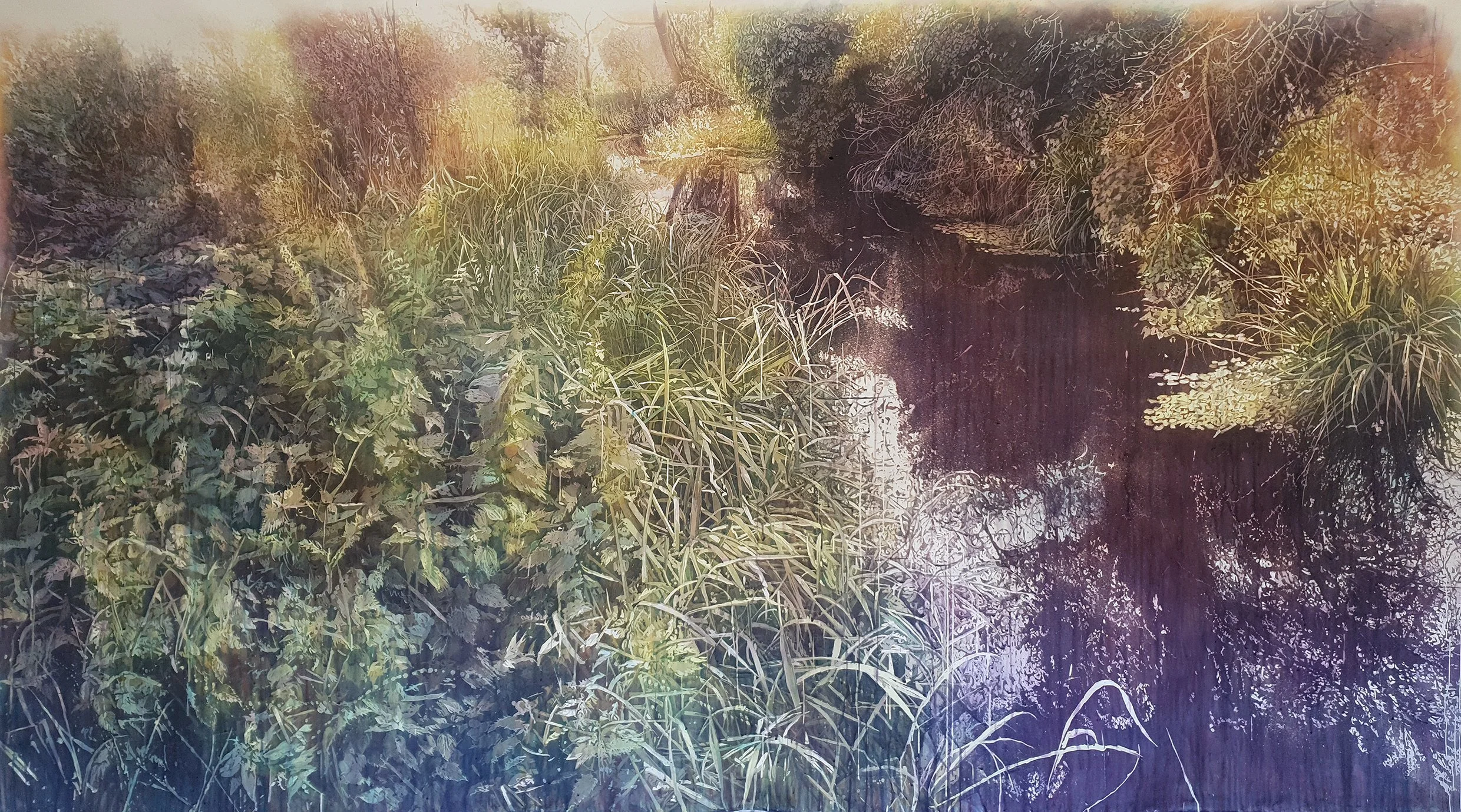
Juliette Losq is an artist based on an island in the River Thames. Her paintings and installations present scenes of civilisational decline, where nature slowly reclaims the remains of the built environment. In her process Juliette uses the idea of models as theatrical settings, whereby her seemingly realistic scenes actually document a constructed reality in the tradition of the Victorian diorama or peep show. Within this context, the drama is subtle and understated. Her industrial hinterlands overrun by nature exude an air of impending danger, portraits of a world teetering on the cusp of collapsing into disorder. Juliette’s medium of watercolour, of washes and drips on paper, and her saturated sepia palette enhance the sense of the uncertainty. The result is contemporary painting with gothic undertones and psychological resonance, depictions of a decay that is both familiar and unnerving.
Edgar Ward in a London-based artist whose sculptures explore the imaginative power of the ruin. An ancient overgrown gateway appears as a portal to the underworld. The stag from the myth of Diana and Actaeon appears on a ceramic shard like a section from an ancient wall frieze. A satyr sits atop an organic contorted pillar reminiscent of Rodin’s ‘Gates of Hell’. Edgar uses a combination of traditional ceramic sculpture and 3D printing such that technically his works they span a long timeline. In his hand-worked ceramics the fluidity of Edgar’s sweeping lines echo erosion over millennia. In his 3D printed works, the printed layers are left visible such that the works build up in synthetic sedimentation. Through these long processes of accretion mythology emerges, suggesting how culture is an organic structure built up over time.
‘The Wages of Decadence’ opens on Thursday 10 September, 6:30 – 8:30pm. To receive the PDF catalogue of works shortly before the exhibition opens please register via the ‘Request PDF Catalogue’ link above.